Water Quality Master Plan
Key Points and Recommendations
Major Findings and Recommendations
Over an approximately 2-year period, CDM Smith worked in close coordination with SWBNO staff to complete the Water Quality Master Plan (WQMP) and establish a clear, achievable vision for the long-term integrity and reliability of the water treatment system. This effort was grounded in comprehensive assessments of existing conditions at each Water Treatment Plant (WTP), collaborative workshops with operations and maintenance staff, and detailed system-wide data analysis. Together, these activities provided the technical basis for the development of the 5- and 30-year Capital Improvement Plans (CIPs) which have been combined into an overall CIP.
The WQMP identifies critical system needs and establishes a prioritized, risk-informed path forward. The major findings and recommendations reflect both the urgency of near-term actions and the strategic investments required to sustain reliable water service over the long term.
The costs presented in the WQMP were developed in general accordance with guidelines established by the Association for the Advancement of Cost Engineering and are considered Class 5 cost estimates, which are typically planning-level estimates with an average +65 percent (%) and -35% cost range. These are high-level costs based upon industry rules of thumb for construction costs, vendor budgetary quotes for major equipment items, and bid results from similar treatment systems in other locations. These costs provide a general order of magnitude of the anticipated project costs, including appropriate markups for undeveloped design details, general conditions, and contingencies. These are not detailed cost estimates for the improvements; therefore, actual project costs will vary. As preliminary and detailed design efforts progress, the scope of the WTP improvements will become better defined, allowing for the development of more precise cost estimates.


Carrollton Water Treatment Plant Phased Replacement
The Carrollton WTP, originally constructed in the early 1900s, has not undergone significant equipment upgrades since the 1950s. As a result, several critical treatment processes are operating well beyond their intended service life and are increasingly vulnerable to failure. The deteriorated condition of these assets creates ongoing operational challenges and significantly elevates the risk of severe service interruptions. Without timely intervention, the likelihood of a consequential disruption will continue to increase. Accordingly, a complete replacement of Carrollton WTP treatment processes is identified as an urgent, high-priority investment and is recommended as a primary focus during the first half of the 30-year CIP.
Table 1: Carrollton Rehabilitation Projects
| System | Project | 2025 Cost Estimate | CIP Years of Construction |
|---|---|---|---|
| Carrollton WTP | Building Replacements | $84,920,000 | 1–3 |
| Carrollton WTP | New Plate Settler Pretreatment (Phase 1) | $489,216,000 | 2–7 |
| Carrollton WTP | New Filter Building and Post-filter Basins (Phase 2) | $802,816,000 | 7–10 |
| Carrollton WTP | New Post-filter Basins (Phase 3) | $301,056,000 | 10–15 |
Risk-Based Projects at Carrollton and Algiers Water Treatment Plants
In addition to Carrollton WTP replacement, a series of high-priority projects at the Carrollton and Algiers facilities were identified through structured workshops with SWBNO staff. These workshops focused on criticality analysis, asset management strategies, and risk-informed capital planning. Projects were prioritized based on relative risk and their contribution to maintaining system resilience and reliable operations. Implementing these projects in parallel with the Carrollton WTP retrofit is essential to sustain interim operability and mitigate system-wide risk. They form the basis of the first 5 years of the CIP.
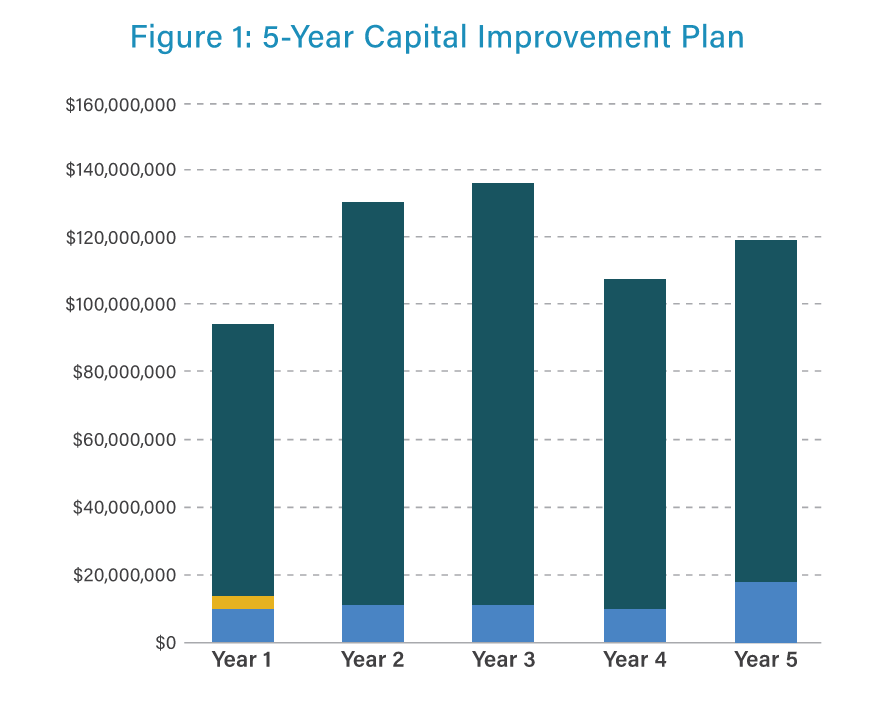
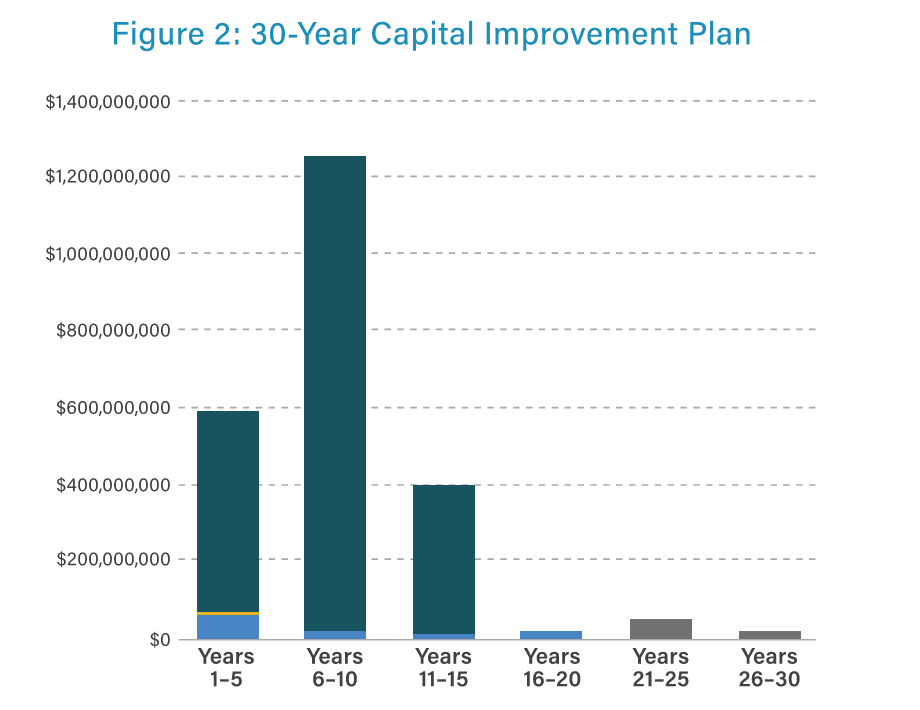
Charts are visual representations of the relative scale and composition of CIP investment by program category and time horizon.
Corrosion Control Pilot Projects
To comply with the U.S. Environmental Protection Agency (EPA) Lead and Copper Rule Revision (LCRR) and address increased corrosion risk associated with seasonal salt wedge intrusion during low Mississippi River flow conditions, the WQMP recommends full-scale pilot projects to evaluate the addition of zinc orthophosphate to finished water at each WTP. Bench-scale testing performed as part of the WQMP scope demonstrated that zinc orthophosphate performs favorably in limiting lead release under elevated chloride conditions. The pilot projects will allow SWBNO to verify treatment performance under full-scale operating conditions before long-term system-wide implementation.
The pilot at Algiers WTP is recommended for immediate implementation, as funding is available and only minor modifications are required. In parallel, design modifications at Carrollton WTP should be initiated to enable execution of a comparable pilot at that facility soon.
Table 2: Water Quality / Treatment Performance Projects (Annual Costs)
| System | Project | 2025 Cost Estimate / Year |
|---|---|---|
| Carrollton WTP | Full-Scale Implementation of Zinc Orthophosphate — First Year | $2,300,000 |
| Algiers WTP | Zinc Orthophosphate Pilot — First Year | $120,000 |
| TOTAL | $2,420,000 | |
Key Findings Summary

Facility Goals Assessment
WTP service goals were identified, discussed, and documented across multiple focus areas, including service reliability, water treatment performance, resiliency and sustainability, and key planning constraints.

Water System Demand and Supply Analysis
No additional treatment capacity is expected to be required to meet long-term average or peak demands at either Carrollton or Algiers WTPs.
While average temperatures and precipitation patterns are expected to increase moderately over time, historical data shows that system demand has not exhibited strong sensitivity to seasonal climate variation.
Continued implementation of leak detection, smart metering, and targeted water main replacement offer significant opportunities to reduce real water losses, easing operational demands on aging infrastructure.
Overall, the findings confirm that future investment priorities should not focus on expanding treatment capacity for future customer needs.

Water Quality Analysis
While current compliance is strong, the evaluation also identified future risk associated with increasingly stringent regulatory requirements under the LCRR and Lead and Copper Rule Improvements (LCRI).

Operations Assessment and Optimization
Pretreatment basins were found to be undersized, and contact basins at Carrollton WTP are hydraulically constrained.
The WQMP recommends piloting of aluminum chlorohydrate (ACH) as the preferred coagulant. Jar tests conducted during the master planning indicate that ACH will reduce the lime concentration and subsequent buildup of lime deposition in the contact chambers.

Asset Management, Planning, and Preparedness
The analysis identified the Old River intake station as the greatest risk to maintaining a level of service (LOS).
This approach provides a transparent, data-driven basis for prioritizing projects for capital planning of the WTPs.

Saltwater Intrusion Assessment
SWBNO is currently near the proposed new lead action level, placing the system at elevated risk.
The Master Plan recommends implementation of zinc orthophosphate to minimize impacts from increased chloride levels in the Mississippi River and to further reduce lead levels in the distribution system.

Funding Analysis
SWBNO is encouraged to pursue both Drinking Water State Revolving Fund (DWSRF) and Water Infrastructure Finance and Innovation Act (WIFIA) financing opportunities in the near term.

Water Treatment Alternatives Development
A preferred alternative to replace Carrollton WTP has been identified for further evaluation and design which includes a conventional water treatment approach with the addition of high-rate plate settler clarification.

Capital Improvement Planning
Replacement of Carrollton WTP will require a phased construction approach to allow continued water production while new facilities are constructed. Ongoing maintenance of critical assets is required for continued level of service as the phased plant replacement occurs.